Modern dating
Should I delete the apps or keep trying for something real?
Sunday, January 18, 2026






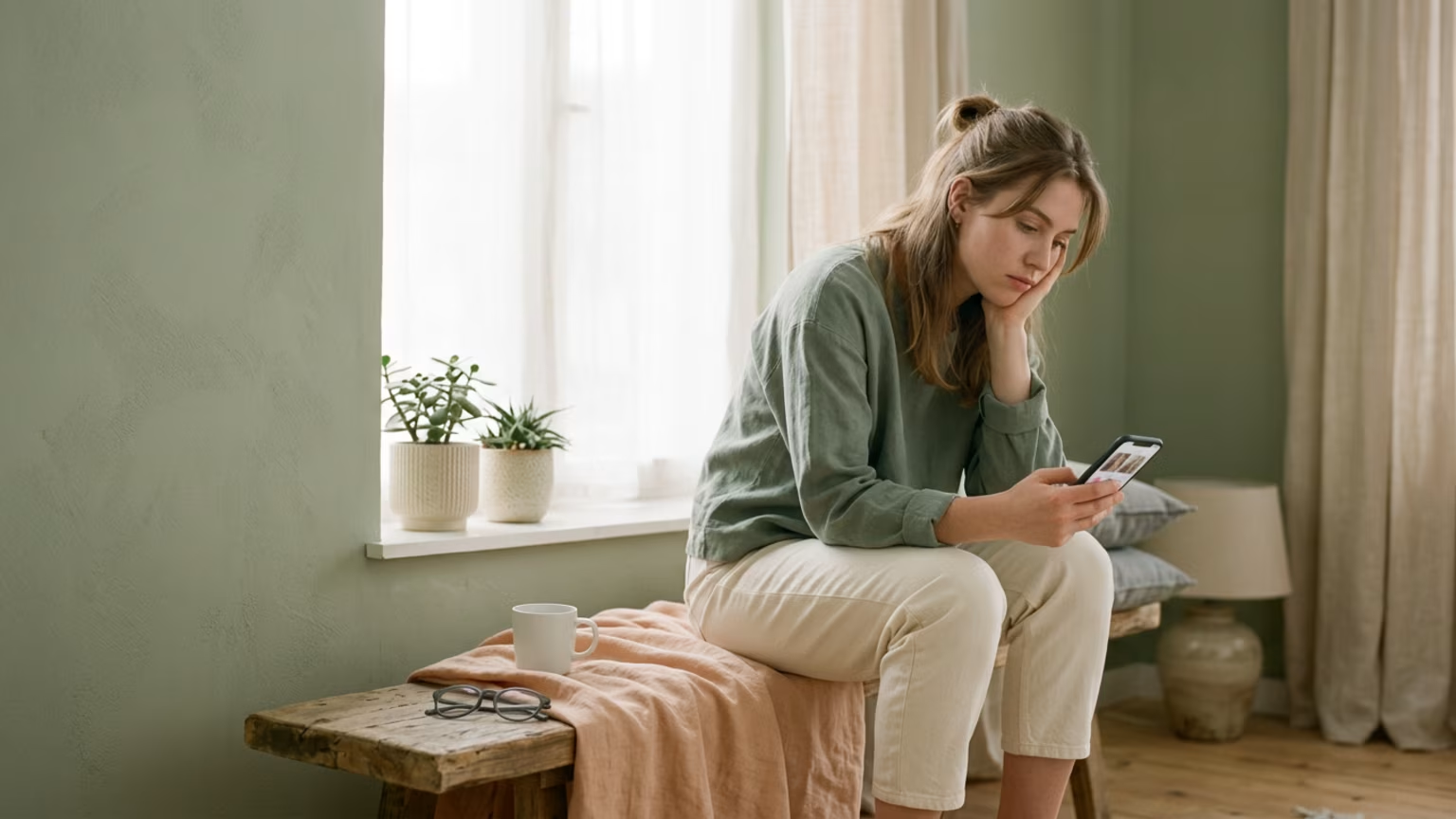
The screen lights up, then stays quiet again. Another match that goes nowhere. Another chat that started warm and then cooled into nothing. It can make a simple question feel very heavy in your chest. Should I delete the apps or keep trying for something real?
This moment can feel like a split. If you stay on the apps, you fear more hurt, more ghosting, more nights staring at the chat screen. If you leave, you fear missing your chance, or falling behind while other people get engaged and married. Below, you will find a calm way to think through this choice so it feels less harsh and more kind to you.
We will look at what this season really feels like, why dating apps can hurt so much, and how to choose what is right for you right now. The hope is not to push you to delete or to stay. The hope is to help you answer your own question about whether you should delete the apps or keep trying for something real, with more peace in your body.
Answer: It depends, but your choice should protect your peace before anything else.
Best next step: Take a 7 day pause from all apps and watch how you feel.
Why: Space shows if apps support you or slowly drain your energy.
Many women describe this season as a loop. Hope when you download the apps, tension when you swipe, then a crash when chats fade or dates disappoint. It is a cycle of tiny highs and deep lows.
There might be nights when you sit on your bed, phone in hand, scrolling through faces that all blur together. You think, "Is this all I am to people, a picture?" You start to feel like you are the problem, even when you have done nothing wrong.
The pressure on your body and looks can grow without you noticing. You might re-take a selfie 20 times or zoom in on every small detail, telling yourself, "If I just looked a bit better, he would reply." This is heavy to carry every day.
Some women notice their mood shifting in quiet ways. More anxiety when a message does not come. Irritation with friends. Less patience at work. A numb feeling where excitement used to be. Even simple joy, like enjoying a meal, can feel harder if your mind is busy thinking, "If I looked different, I would have more matches."
There can also be a strong fear of missing out. It can feel like everyone else is meeting partners online, moving in, getting married, posting pictures, while you are stuck in chat threads that end in silence. This is painful, and it makes it harder to hear your own needs.
At the same time, a part of you still wants love and real connection. You still want to share your life with someone kind. This tug between "I want love" and "I cannot do this anymore" is often what leads to the question, "Should I delete the apps or keep trying for something real?" It is a very human question, and it makes sense that you are asking it.
This happens more than you think. Dating apps are built in a way that can be very rough on the heart and mind, especially over time. There are a few common reasons.
On apps, there are endless faces. This sounds good, but it can become too much. When you see many options, it is easy to think there is always someone better one swipe away.
This can make people judge fast. Often, they decide in seconds based only on photos and one or two lines. That means your full self, your kindness and humor and values, do not even get a chance to be seen. This can leave you feeling disposable, even though the problem is the system, not you.
If you are sensitive to rejection, the apps can press on that spot again and again. Ghosting is very common. Ghosting means someone stops replying without saying why. It is confusing every time it happens.
When you are hurting, a slow reply or no reply can quickly turn into, "I must be boring," or "My body is the problem," or "No one ever chooses me." Over time, your brain can start using dating app results as a score card for your worth, even though that is not fair or true.
Swiping and matching can feel like a quick rush. A new match, a flirty line, a heart reaction. For a moment, it can feel like, "Okay, see, I am wanted." But if things do not turn into a real, steady connection, that rush fades fast.
This push and pull can become a habit. You reach for the apps when you feel lonely or low, hoping for relief, but most of what you get is more surface contact, not deep care. This can leave you feeling even more lonely afterwards.
Attachment style is the way you tend to connect in close relationships. For example, if you have an anxious attachment style, you might fear being left or ignored. Anxious attachment can sound like, "Did I say something wrong?" "Is he losing interest?" "How do I fix this fast?"
If you lean more avoidant, you might pull away when someone likes you, or feel trapped when someone wants more closeness. Avoidant attachment can sound like, "This is too much," or "I do better on my own."
Dating apps can wake up these patterns quickly, because they are full of mixed signals, half connections, and unclear intentions. This can make you feel like you are constantly on edge, even when you are just sitting on your couch.
Many women notice that being on apps for a long time changes how they see their bodies. When matches are based so much on photos, every small change, every angle, every outfit can feel like it decides your worth.
This pressure can lead to strict rules with food or exercise, or a strong urge to control your body in harsh ways. Even if you do not act on those urges, the thoughts alone can be draining. Your body becomes a project to fix, instead of a home to care for.
Choosing whether to delete the apps or keep trying for something real is not a one-time choice forever. It is okay if your answer changes over time. The goal is to choose what supports your peace and your self-worth right now. Here are some gentle ideas you can try.
Before you decide to keep going or delete everything, give yourself a pause. This can be 7 days, 10 days, or 2 weeks with no app use at all.
During this pause, write down how you actually feel without the constant swiping and checking. Do you miss the apps in a healthy way, like missing a fun hobby? Or do you mainly miss the rush that covers loneliness for a moment? This gives you honest data from your own body.
A simple rule you can try is, "If it costs your peace, it is too expensive." You can use this when you think about redownloading, starting new chats, or saying yes to dates you do not really want to go on.
If your pause shows that the apps do not drain you completely, and you still want to use them, you can try using them in a more gentle way.
A helpful rule can be, "If I feel worse after 3 days in a row, I step back." This keeps you from slipping back into old patterns for months without noticing.
When you are on the apps, try to filter for values, not only for looks or witty one-liners. This supports your wish for something real.
Exclusive means you both agree to stop dating others and focus on each other. If you want something real, it is okay to ask gentle questions that lead toward clarity, like, "What are you looking for right now?" or "Are you open to something more serious if it feels right?"
When someone unmatches, does not reply, or disappears, your first thought might attack you. "I talked too much." "I am not pretty enough." "I ruin everything." These are painful thoughts, not facts.
You can try a new story. "This was a mismatch, not a measure of my worth." "Their silence is about their capacity, not my value." You can even write these lines on a note in your phone and read them when you feel that sting.
Ghosting and low effort are more about the dating culture and the quick nature of apps than about you as a person. You deserve mutual interest, mutual care, and respect. Mutual means both people want it, not just you doing the work.
There is a gentle guide on this feeling called I worry about getting ghosted again. It might help you feel less confused when someone pulls away without a word.
Whether you stay on the apps or not, building a fuller life offline will always help. It makes your world bigger than dating alone.
Meeting people through shared activities often feels calmer than matching with strangers. You see how they treat others, how they show up over time. This can rebuild your trust in people and in your own judgment.
Pause for a moment and ask, "Has my use of dating apps changed how I see my body?" If the answer is yes, it might be time to step back and care for that part of you.
If your thoughts about food and your body feel loud and scary, it can help to talk to a therapist or a trusted friend. You do not need to fix this alone or fast.
The phrase "something real" can mean many things. It can help to define it in your own words.
Write a small list of 3–5 things that mean "real" to you. Let this list guide your choices on and off the apps. If someone is charming but cannot offer these things, your answer is already there.
You might like the guide How to know if he is serious about us if you often feel unsure what someone really wants.
Healing in this area often looks quiet from the outside. You might decide to delete the apps for a month and realize you sleep better. Your days feel less like waiting. Your self-talk becomes softer.
Or you might keep the apps but move in a new way. Fewer matches, less small talk, more care with who you give your time and body to. You might say no faster when something feels off, and yes slower when you need more time.
Over time, you may notice that your mood does not swing so sharply with every message or silence. You might feel more comfort being single, not because you gave up, but because you trust that your worth is steady with or without a partner.
From that place, your question "Should I delete the apps or keep trying for something real?" will feel less like panic and more like a choice you can revisit as needed. You are allowed to change your mind when your needs change.
A good sign is if the apps make your mood worse most days. If you feel more anxious, numb, or critical of your body after using them for at least two weeks, it may be kind to pause or delete them. Try a 14 day break and write down how you feel without them. If life feels lighter, that is useful information about what you need right now.
This fear is very common, especially when friends are getting engaged or having children. Remember that people meet partners in many ways, not only on apps. You can protect your chances at love by caring for your energy and self-worth, not by forcing yourself to stay in spaces that hurt you. If a break from apps gives you more peace, that peace will only help your future relationships.
Small changes can help if they feel fun and light, like adding a clear photo with a real smile or sharing a hobby you love. But if you find yourself obsessing over every angle or rewriting your bio again and again, the deeper issue is probably how the apps make you feel, not just the profile. Try this rule first, "If profile changes feel stressful, I step away for 3 days." Then decide from a calmer place.
Yes, many people still meet partners through friends, work, hobbies, and community spaces. It might move slower than swiping, but slow can be good for your nervous system. Focus on building a life you like being in, and let dating be one part of that, not the only goal. Often, feeling grounded in your own life makes it easier to notice and welcome healthy people when they do appear.
If you feel a strong pull to check the apps many times a day, it can help to create small barriers. Delete the apps from your home screen, set 1–2 short windows where you are allowed to check, and ask a friend to gently check in on how that is going. If the urge still feels very strong and your mood is low, talking to a therapist or counselor is a kind next step. You deserve support with this, just like you would with any other hard habit.
Open your notes app and write two short lists. On one side, write "How the apps make me feel most days." On the other side, write "How I want to feel in dating." Look at both lists and circle one small action that would move you closer to the second list, even by 5%. This might be a break, a boundary, or a new way to meet people.
This choice about deleting the apps or keeping them is not a test you must pass. It is a chance to listen more closely to yourself. It is okay to move slowly and to choose what feels most gentle to your mind, body, and heart right now.

A collective of writers and researchers specializing in behavioral psychology and relationship recovery.


Uncrumb is a calm space for honest relationship advice. Follow us for new guides, small reminders and gentle support when love feels confusing.
Learn how turning inward and reducing rumination after a loss helps you build stronger relationship boundaries, heal your heart, and reclaim your self-worth.
Continue reading
Uncrumb is a calm corner of the internet for women who want kinder love choices. Read the guides that fit your story, take what helps and return whenever you need a bit more clarity.